


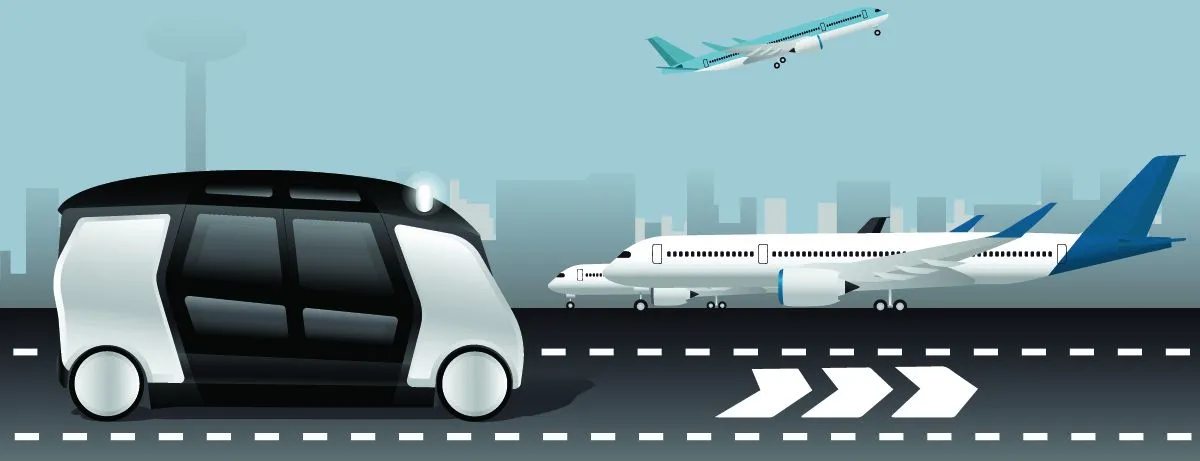
Driverless vehicles and automated guided vehicles (DVs and AGVs)
The differences between automated guided vehicles (AGVs) and driverless vehicles (DVs) are fundamental and decisive for the logistics industry. AGVs essentially follow predefined routes that they are programmed for, much like trains running on strictly fixed tracks. These vehicles can only operate on their programmed routes and stopping points, which limits their flexibility.
Driverless vehicles (DVs), by contrast, have a degree of autonomy and can work out alternative routes based on information stored in their memory. This autonomous capability allows them to adapt to dynamically changing environments, which is a great advantage in warehouse logistics and airport transport.
On the road to progress
Driverless forklifts are now an integral part of how modern warehouses operate, although these devices are often pre-programmed or remotely controlled, which places them in the AGV category. The real breakthrough would be full autonomy, which would allow these vehicles to operate without human intervention.
A milestone in the development of autonomous vehicles was DARPA's 2004 programme, which set the goal of creating fully autonomous ground vehicles. The first tests were not entirely successful, but significant progress was made in the years that followed. A vehicle developed jointly by Carnegie Mellon University and General Motors, for example, was able to complete a 96 km course in less than six hours.
Since then, companies such as Tesla, Uber and Google have made significant efforts to develop and test autonomous vehicles. These vehicles can already carry passengers safely without a driver, and they are also being tested by companies such as ANA, which uses driverless electric buses for airport transport at Tokyo's Haneda Airport.
Human factors and challenges
Although the technological progress is impressive, the use of autonomous vehicles is not without its challenges. Two accidents involving pedestrians have seriously called into question the safety of driverless vehicles on public roads. In one of these cases, one of Uber's self-driving vehicles caused a fatal accident in Arizona when a woman pushing a bicycle laden with shopping bags stepped in front of the vehicle. In another case, a human-driven car caused an accident in San Francisco in which a pedestrian was thrown in front of a driverless Cruise robotaxi, which could not stop in time and hit the pedestrian.
These cases highlighted that the technology and safety of autonomous vehicles on public roads need further development before they can become widespread.
Future prospects
While the widespread use of driverless vehicles on public roads may still be a decade away, their use in warehouses and airports is just around the corner. Large warehouses and logistics areas with restricted access provide an ideal setting for such vehicles, as the chance of accidents there is much lower.
Pioneering projects and technological developments
One of the pioneers in this field is a company called Aurrigo, which has been building driverless "pods" for years. These vehicles were initially designed to carry passengers, but the focus later shifted to freight. Aurrigo recently reached an agreement with International Airlines Group (IAG) to demonstrate its baggage handling solutions at Cincinnati/Northern Kentucky International Airport (CVG). It has also signed a European contract for cargo transport at Stuttgart Airport (STR).
Aurrigo and UPS are also working together to deploy autonomous electric vehicles called Auto-Cargo, designed to carry heavy loads to and from aircraft. These vehicles can carry a standard full-size pallet or two half-size aviation ULDs, up to a total load of 7.5 tonnes.
Air traffic worldwide has returned to pre-Covid levels, but staff remain scarce and work under great pressure. Trade unions welcome the introduction of driverless vehicles, as they automate routine work and thereby improve the safety of human workers.
Advanced technology in everyday use
Vehicles of this type are equipped with advanced sensor systems, including LiDAR and stereo cameras, which allow them to analyse their surroundings dynamically. These technologies enable the vehicle to recognise approaching objects, whether mechanical or human, and respond to them appropriately.
Aurrigo's example is just one of many showing that autonomous vehicle technology can already be applied today, especially in places with restricted access such as warehouses or airports. Although full use on public roads may still be some way off, given the pace of progress there is no question that it will be an inevitable part of the future.
The original Eureka magazine article can be read at the link below:
https://eurekapub.eu/technology/2024/03/25/rethink-and-reroute?fbclid=IwY2xjawEpSLRleHRuA2FlbQIxMAABHfaVChWMHbFOn6phC3JtP4hBAXtla_SIuQ9l87PwWZzw1yAeBzOs3gweNw_aem_2GIBL8GgYwvGiqUVb7zSyw