

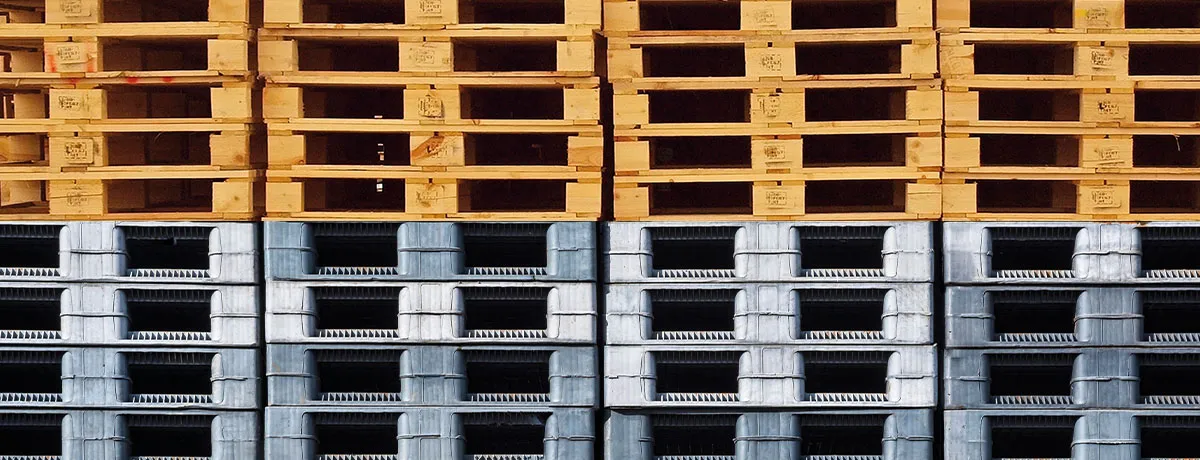
Wood or plastic?
Pick up any materials handling or logistics magazine today and you are likely to find articles and advertisements comparing the pros and cons of plastic and wooden pallets.
In this article, we compare these two types of pallet as impartially as possible to find out which might be the best fit for your business.
Pallet properties
Cleanliness and hygiene
Where pallets need to be washed thoroughly, plastic has the advantage of being a non-porous material – which also copes with spills and odours. Wood can be cleaned carefully, but its absorbency is a problem. It can be structurally weakened by water and contaminated by absorbing spilt liquids. Nevertheless, wood is still suitable for most hygienic industries, such as the food industry, but plastic is starting to take over where exceptional cleanliness is required. In addition, plastic pallets generally look neat and clean.
Regulatory compliance
Many countries, including EU countries, require incoming wooden pallets and wooden packaging materials to comply with ISPM 15 regulations. The aim is to prevent the spread of diseases and pests. To meet the requirements, they must be heat-treated and officially stamped. Plastic pallets are exempt from these requirements, as their material cannot be infested by microbes, moulds or insects.
Durability
Under normal conditions, plastic pallets last much longer than wooden ones. Their material is hard-wearing and resistant to accidental damage. Heavy impacts can weaken and distort the structure of wooden pallets, whereas plastic pallets are more likely to absorb impacts and regain their shape. When damaged, however, wooden pallets are much easier to repair, while damaged plastic pallets will probably have to be scrapped.
Impacts on wooden pallets can produce loose nails, splinters and sharp broken pieces of wood, which can damage or contaminate goods and injure the people handling them. To a lesser extent, rubbing, scratching and knocking of wooden surfaces during everyday handling can be enough to release dust and small fragments of wood. These can be a problem in sensitive work areas.
Wooden pallets stored outdoors can be damaged by wet conditions, whereas plastic is unaffected. In most climates plastic is more weather-resistant – but bear in mind that extreme heat can deform it and extreme cold can make it brittle and easy to break.
Weight and strength
Regardless of their material, pallets must be specified according to their maximum load capacity. They are available in many designs, including versions for very heavy loads, made from both materials. Plastic pallets provide greater stability, as their strength is distributed more evenly throughout their structure.
For a similar load capacity, plastic pallets are significantly lighter than wooden ones. This reduces fuel-related transport costs. Space-saving, nestable plastic pallets can bring further fuel savings by reducing the number of vehicle journeys needed to deliver and return empty pallets.
Uniformity
Plastic pallets are more consistent in size and weight, and their shape changes less over time. This can be important where accurate load calculations are essential, or where pallets are used in automated handling systems with tight tolerances. Wooden pallets can nevertheless meet these needs if they are properly designed, maintained and handled.
When empty pallets are stacked high to make optimum use of storage space, consistently sized and shaped plastic units can create more stable stacks. They can also be designed with a ribbed, non-slip surface to minimise the risk of slipping. Wooden pallets provide natural friction thanks to their rougher material.
Customisation
Wooden pallets can be customised relatively easily based on the capacity, size, handling methods and other factors specified by the user. Custom plastic pallets are less commonly available and can be very expensive.
Sustainability
The sustainability arguments for plastic and wooden pallets are rather complex, but most people agree that wood is the greener choice. First of all, plastic comes from a non-renewable resource. Wood is not only renewable but also has a negative carbon footprint, as trees absorb CO2. Wood from sustainably managed forests is particularly good from an environmental point of view, and pallet manufacturing tends to use wood waste that would otherwise go to waste anyway.
Wood and plastic can be recycled in different ways. Plastic can be melted down, processed into granules and used to make other products. Even if these new products are themselves recyclable, there eventually comes a time when the plastic is disposed of as non-biodegradable waste. Wood, on the other hand, eventually biodegrades and its nutrients return to the Earth's natural cycle. Until then, it can be reused in other timber structures or broken down into useful materials such as mulch and sawdust.
Manufacturing and recycling plastic pallets is generally more energy-intensive and produces more carbon dioxide. On the other hand, because plastic lasts longer, fewer replacement pallets need to be produced in the long run. Meanwhile, the benefits of weight reduction can reduce transport-related pollution.
Costs
Although the purchase price of plastic pallets is significantly higher, this can be offset by ongoing economic benefits – depending on your application. Think, for example, of the longer service life, lower transport costs, easier cleaning and the ISPM 15 exemption.
All in all, it is almost impossible to say which type of pallet is "better". There are many arguments for and against both, which makes this seemingly simple problem an extremely difficult question.
The answer may be different for every company and every set of operating conditions. Before use, we recommend that you consider the arguments above and choose the type of pallet that best suits your needs.
And for your materials handling tasks, choose high-quality, reliable Caterpillar forklifts, available in Hungary exclusively from Niketrans!