
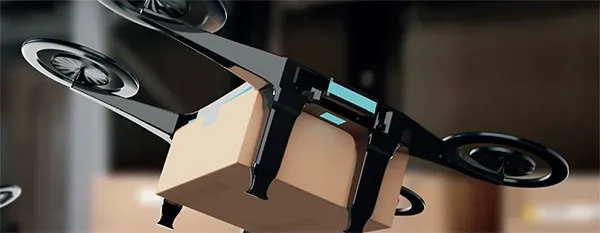
Drones, or UAVs (unmanned aerial vehicles), are increasingly used in a wide variety of applications, such as firefighting, filming and photography, and military tasks. Now they are also starting to gain ground in the world of warehousing and logistics. At a time when delivery within 24 hours is becoming the norm, companies are looking for new solutions to speed up deliveries. In this article, Eureka magazine, together with Gian Schiava and EYESEE, one of Europe's leading developers of logistics drones, examines their use and applications.
We meet Clément Roulet, the company's Vice President of Marketing. He is one of the co-founders of this start-up based in Grenoble, France. As early as 2015 they recognised that drones could play a major role in keeping warehouse stock records up to date, which was a major headache for many companies. Joining forces with three other founding partners and other experts, such as the WMS (warehouse management system) supplier Hardis, they began developing an inventory drone.
After a number of patents, a new navigation system and prototypes, the first projects were delivered, and in 2022 EYESEE became an official company.
Accuracy is everything
Today, drones in the warehouse are used primarily for inventory accuracy. The drone itself is an autonomous flying device measuring approx. 50 x 50 cm, fitted with ordinary Zebra readers for reading labels containing 1D (barcode) or 2D (QR) codes. They also have an HD camera and obstacle-avoidance technologies to guarantee the safety of warehouse staff.
The drone comes in a complete carrying case together with seven batteries. One battery lasts about 20 minutes. The hardware is complemented by the EYESEE App, a tablet application for supervising task execution, with real-time video feedback, safety mechanisms and many other functions. The package is completed by the software needed for mapping, data processing, reporting and managing the drone fleet. All the software was developed in-house.
The inventory process is surprisingly simple. Customers need only one operator to carry it out. This person receives both online and on-site training in advance. When ready to start the stocktake, the operator selects a few aisles, which are temporarily closed off. The rest of the warehouse continues working as usual.
Unlike, for example, controlling drones while filming, the operator does not need a joystick and does not have to navigate. Most of the work has already been done before the flight begins. A complete digital copy of the warehouse has already been created, with all measurements, routes, equipment and inventory. All that is needed is to place two beacons at either end of the aisle. No physical adjustments or installation are required in the warehouse! The operator then assigns "missions" (tasks) to the drone via the app, and the device starts flying and recording.
A drone can scan up to 500 pallet positions in an hour. Traditionally, with people and vehicles, around 60 pallet locations are typically checked per hour. The drone establishes whether there is a pallet and, if so, reads the pallet's data label. It compares this with the data from the WMS.
In this way, discrepancies can be identified. In a typical warehouse, data accuracy is between 95 and 99%. That 1% discrepancy may seem small, but in a warehouse with 25,000 pallet locations it would mean that WMS data would have to be corrected in 250 cases.
Customers are typically large companies with even larger warehouses, such as 3PL (third-party logistics) providers. Deploying drones means that the reliability of stock data becomes much better. The other benefit is the huge amount of time that can be saved each year compared with traditional stock checks.
The drones can be bought outright, leased long term or even used as IaaS (Inventory as a Service). IaaS is a key solution that offers the option of paying for a stock-checking service.
Other applications
In addition to stock checks, drones can also be used for visual inspection. In this application, the operator checks for pallet damage, damaged goods, incorrectly or improperly placed pallets and so on. This is particularly useful in warehouses with very high racking. So far, drones have mainly been used with pallet racking systems, and less so with narrow-aisle shelving or advanced automated storage systems.
Outside the warehouse, there is also great interest in using drones as a means of delivery. Potential benefits include lower costs, faster delivery, less road transport and therefore lower air pollution. Companies such as UPS, Amazon and Google Wing are currently developing order delivery projects. To use the service, customers need to install an app on their mobile phone that can track the drone's exact location and determine the collection point. For now, this application is still at the experimental stage, as many obstacles (legislation, weather conditions, safety) still have to be overcome.
Whatever happens, the technology will continue to develop, making drones even easier to deploy. As Clément Roulet points out: "The fast inventory process, together with the simplicity, the short payback period and the almost instant results, make the decision to use drones very easy. In our case, once warehouse managers get to know the possibilities, it is only a matter of time before we are working together."
The original article is available at the following link
https://eurekapub.eu/?s=A+fly+on+the+Warehouse+Wall