
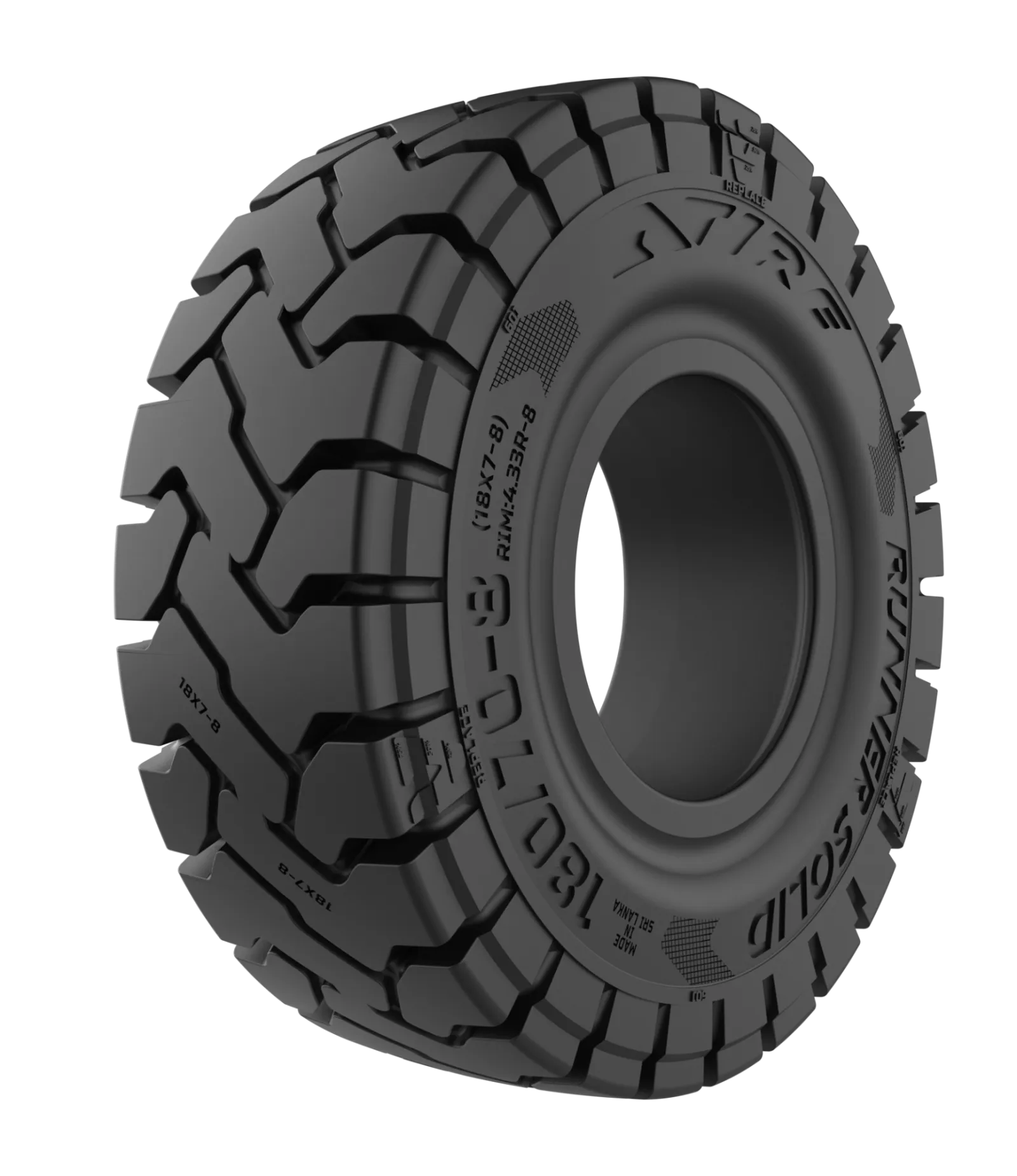
In today's article, we take a closer look at super-elastic solid forklift tyres.
The first question many people ask is what advantage a solid tyre has over a pneumatic one. Its main advantage is that it lasts 2–3 times longer than its pneumatic counterpart. This is because it has a much thicker tread cross-section. A further advantage is that it is resistant to punctures and mechanical damage. In industrial environments, trucks often have to work on ground contaminated with metal debris (nails, screws, metal shavings), which can easily puncture a pneumatic tyre but does little damage to a solid one.
Once we have decided on solid forklift tyres, which kind should we choose? My short answer is: only a quality tyre that is elastic yet wear-resistant – in other words, durable! Why does this matter?\ The answer is simple: for the same reason as comfortable footwear. In a light shoe with a flexible sole and a good insole, our feet don't swell and it feels good to wear.\ Otherwise it is agony and can even lead to health problems, e.g. poor posture or curvature of the spine.\ With forklifts, it makes a big difference how much stress acts on the load-bearing and steering components, the axle, the bearings, the pins and the ball joints! As a forklift's axle has no built-in suspension, the tyre alone absorbs the vibration. If the tyre's damping is poor, components wear loose, which can ultimately mean replacing the entire rear axle. That means repair costs running into several million forints. This is why it is extremely important for the tyre to provide not only high wear resistance but also exceptional elasticity!\ If the tyre lacks elasticity, the forklift's service requirements increase significantly!
Ergonomics is just as important: if the operator is being shaken about and therefore cannot concentrate on lifting, this can lead to accidents.
The operator's own health is also at stake. In the 21st century, it is a basic expectation that we provide our employees with the conditions needed for optimal, ergonomic working!
The wear resistance of a forklift tyre is another factor that should not be overlooked. On counterbalance forklifts, the rear steered wheel constantly turns – in other words, it scrubs. If the compound is too soft, the tyre wears too quickly; if it is too hard, it loses its elasticity. One of the most important characteristics of premium tyres is that natural rubber is mixed into the compound, providing the necessary elasticity while also ensuring sufficient strength.
Every premium tyre manufacturer has its own test bench, where tyres are worn down at a constant, steady speed. The heat generated in the tyre and the wear are measured. Frictional heat causes the tyre material to heat up. A quality rubber compound, however, can dissipate this heat effectively, so no cracks form in the tyre and the tread does not separate.
One of the most fundamental problems with medium-quality tyres is tearing and tread separation caused by overheating, which can lead to workplace accidents while the forklift is in operation!
If the rubber compound is not right, it can lead to premature wear, tearing and accidents!
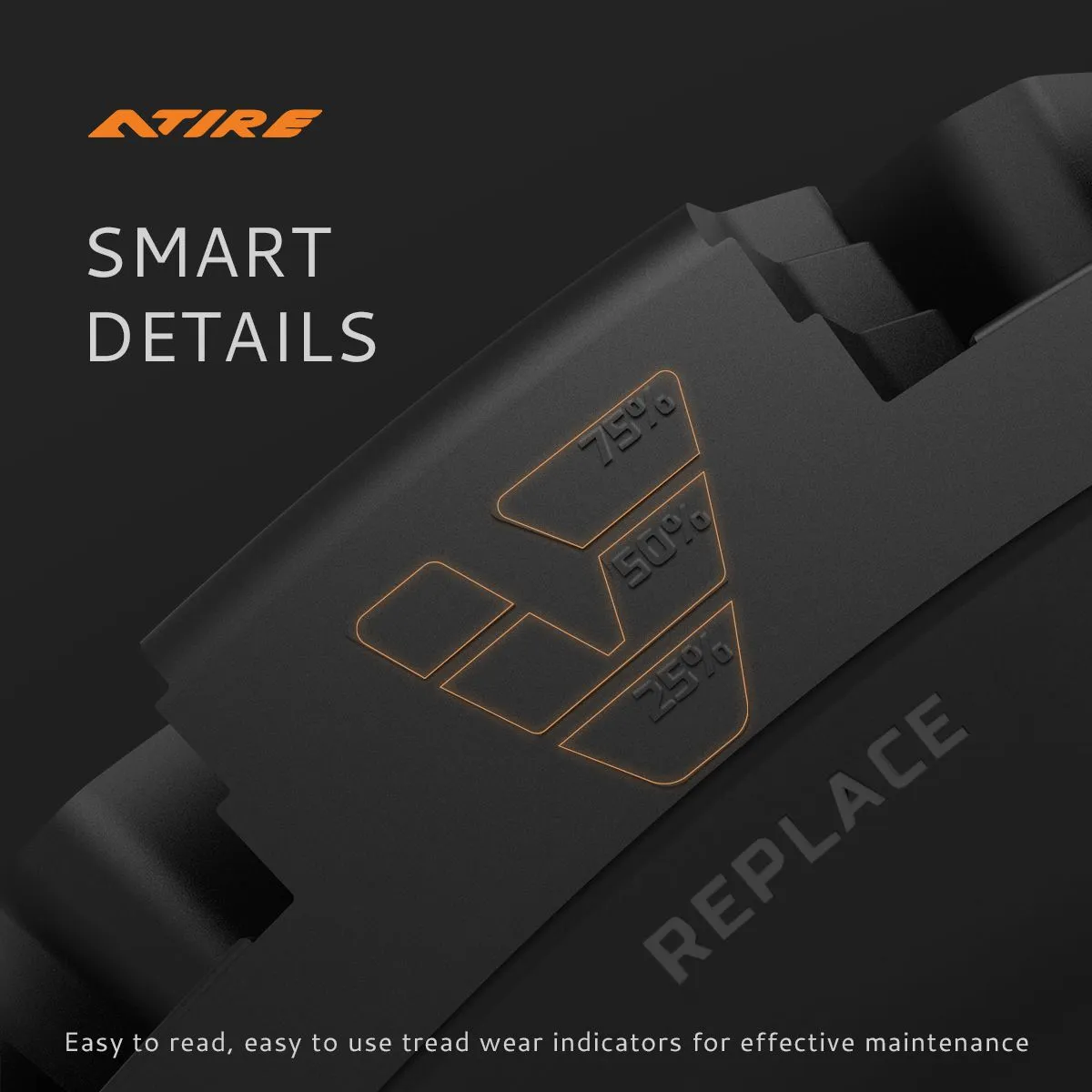
It is important always to check that the tyre has not reached the wear line, which most manufacturers mark with 60J. Once this has been reached, the forklift tyre must be replaced immediately and the forklift must not be used any further. The reason is that below this line there is a layer structure that is no longer suitable for carrying loads. The manufacturer of ATIRE tyres even pays attention to details such as a percentage wear indicator. The current wear of the tyre can be tracked on its sidewall. The current percentage value shows the tyre's remaining service life. The REPLACE marking indicates the latest point at which the tyre is completely worn and must be replaced.
Unfortunately, many on the Hungarian market still look only at the price of the tyre and choose the cheapest. As the saying goes, buy cheap, buy twice. Applied to tyres: cheap no-name tyre, frequent replacement. This means that, as described above, cheap tyres last only about half or a third as many operating hours as quality industrial forklift tyres. Furthermore, they come with no manufacturer's warranty against tearing, breaking or tread separation.
It is worth looking at tyre cost per operating hour, as this is how tyres of different quality can be compared. If we divide the price of a given tyre by the number of operating hours for which it was used (from fitting to removal), we get the tyre cost per operating hour. We must also take into account that fixed costs, such as tyre fitting and call-out costs, will also arise more often.
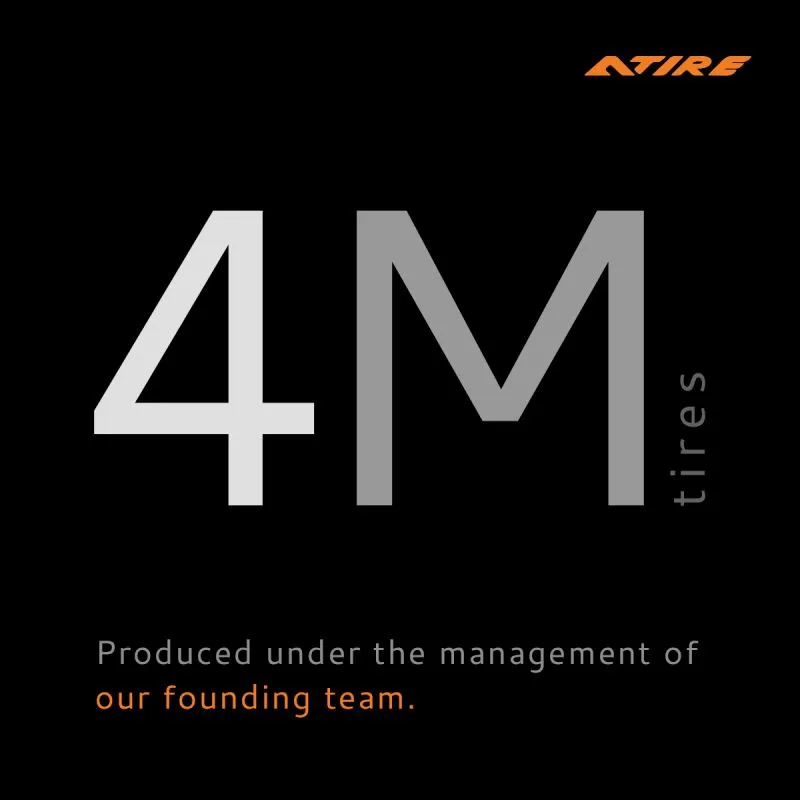
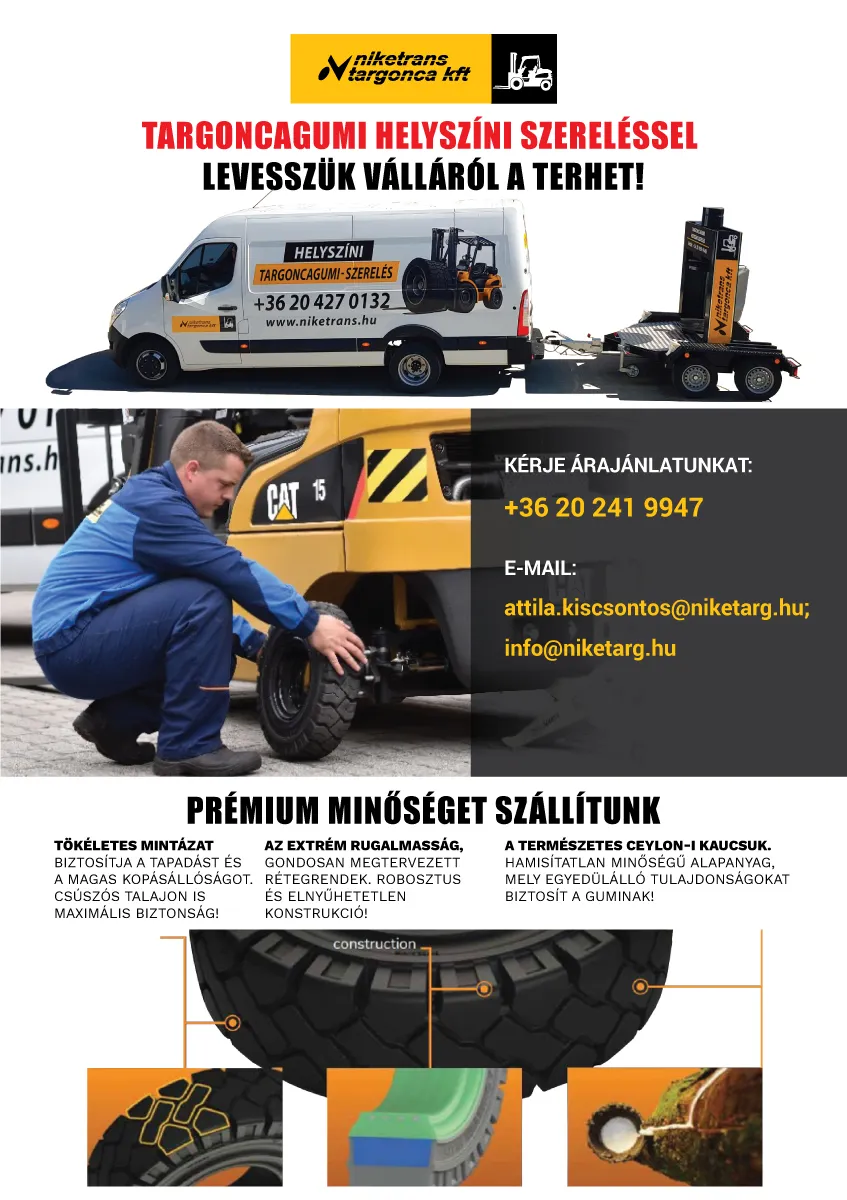
In summary: a quality tyre is kind not only to your forklift but also to your wallet! For all this, our company recommends the ACHIEVER, ACHEIVER PLUS and ATIRE tyres, which have been tested and proven over many years. Our manufacturer has built the experience of 4 million forklift tyres produced into the product, which is continuously being developed.
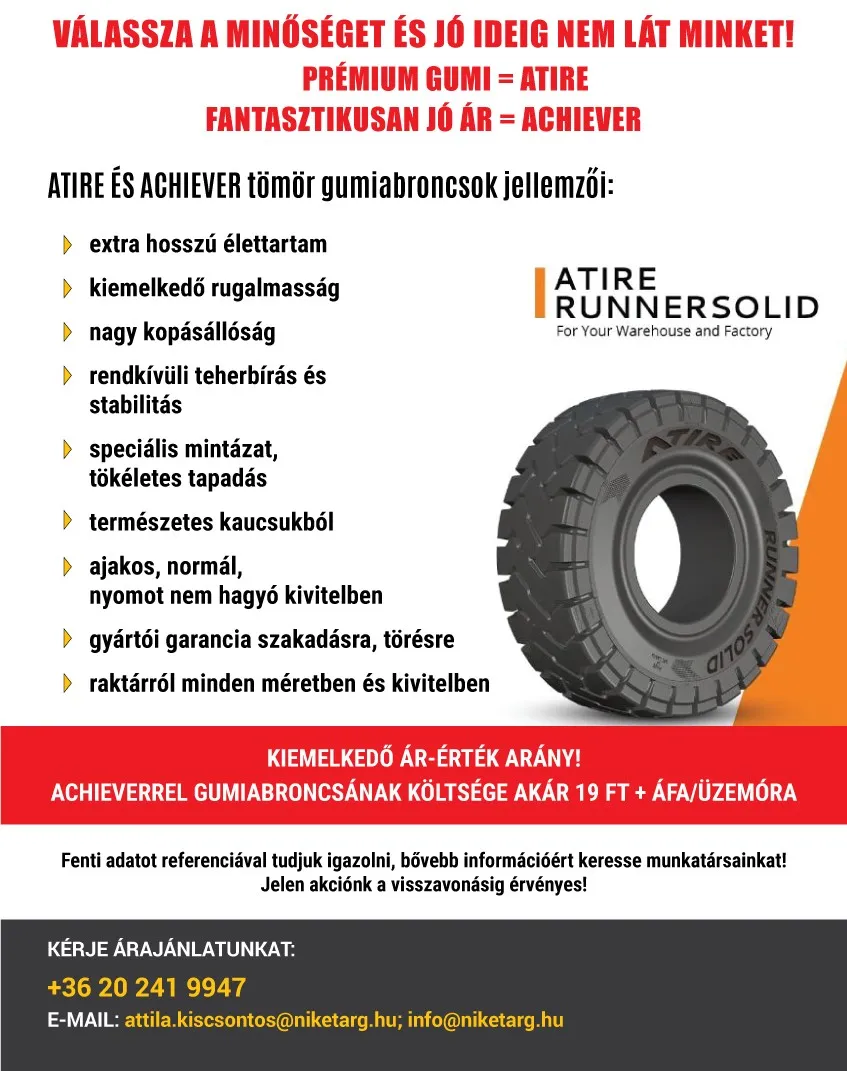
We offer everyone what their specific operating conditions require. Our PREMIUM industrial solid forklift tyres offer an extra-long service life, high wear resistance and exceptional load capacity.
During our on-site tyre fitting, our company pays close attention to inspecting the condition of the forklift's axle as well, as this is a basic requirement for the truck's stability. With a damaged axle, the risk of lifting and loading tasks increases. For us, it is essential that our Customers are satisfied not only with our products but with all of our forklift-related services!\ With this in mind, in 2018 we launched on-site forklift tyre fitting, where our company undertakes to change the tyres at the customer's premises. We minimise the time the forklift is out of production,\ so that our Customers can focus on what really matters to them: their own core business!
Author:
Mihály Kovács, chartered mechanical engineer, lifting equipment expert